
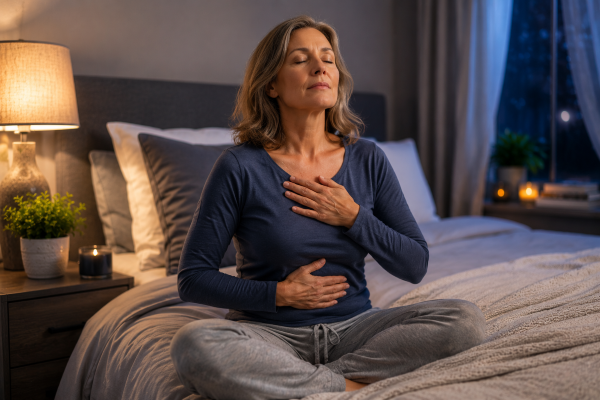
If sleeplessness has you staring at the ceiling after 40, breathing exercises for sleep may be the simplest, most accessible tool you are not using yet. Controlled breathing directly influences your nervous system—slowing your heart rate, lowering cortisol, and signaling your body that it is safe to rest. Unlike supplements or sleep hacks, breathing costs nothing, has no side effects, and works almost immediately when practiced correctly. This guide covers four evidence-informed breathing techniques and exactly how to practice them for better sleep after 40.
Quick Answer: How Breathing Techniques Help You Sleep
Breathing exercises for sleep work because they activate the parasympathetic nervous system—the rest-and-digest counterpart to the fight-or-flight response. Slow, intentional breathing reduces heart rate variability, lowers cortisol, and can shift your nervous system from alert to calm in minutes. After 40, when stress and hormonal changes often keep your nervous system in a heightened state, these techniques become especially effective sleep aids.
Why Breathing Is So Effective After 40
Your breath is the one autonomic function you can consciously control. By changing the pace and depth of your breathing, you send direct signals to your brain about whether you are safe or threatened. Slow, deep breathing tells your vagus nerve to switch into rest mode. This matters after 40 because stress, hormonal shifts, and aging-related changes in circadian rhythm often leave your body stuck in a mild state of alert at bedtime. Breathing exercises are a direct countermeasure—no pills, no gadgets, no waiting for effects to build up.
4 Breathing Techniques for Sleep
1. The 4-7-8 Breathing Method
Developed by Dr. Andrew Weil, this technique is one of the most studied and widely recommended. The pattern is simple: breathe in through your nose for a count of 4, hold the breath for a count of 7, and exhale slowly through your mouth for a count of 8. The extended exhale is the key—it activates the vagus nerve and triggers relaxation. Practice four to six cycles when you are in bed with the lights off. It can reduce sleep onset latency noticeably within a few minutes for many people.
2. Box Breathing
Box breathing uses equal counts for each phase: breathe in for 4, hold for 4, exhale for 4, and hold with lungs empty for 4. Visualize tracing the four sides of a box as you move through each phase. This technique is especially helpful when racing thoughts or anxiety are keeping you awake. It is used by Navy SEALs to stay calm under stress, and it works equally well for bedtime racing thoughts. See Why Is My Mind Racing When I Try to Sleep? for more on quieting an overactive mind at bedtime.
3. Alternate Nostril Breathing (Nadi Shodhana)
This yogic breathing technique involves alternately closing one nostril while breathing in through the other. Use your right thumb to close the right nostril, inhale through the left, close the left nostril with your ring finger, release the right, and exhale through the right. Inhale through the right, close it, release the left, and exhale. Repeat for five to ten cycles. This practice balances the nervous system and has been associated with reduced anxiety and improved heart rate variability, both of which support sleep quality after 40.
4. Progressive Muscle Relaxation With Breath
Combine controlled breathing with a body scan that progressively tenses and releases each muscle group. Start at your toes: inhale and tense for five seconds, exhale and release for ten. Move up through your calves, thighs, hips, abdomen, chest, shoulders, arms, hands, neck, jaw, and face. This technique works doubly well—breathing calms the nervous system while muscle release reduces the physical tension that keeps many adults over 40 awake. For more on how stress and tension affect sleep, see How Stress and Cortisol Ruin Sleep Quality After 40.
When to Practice Breathing Exercises
Breathing techniques work best when practiced at specific times. Here is when to do them for maximum sleep benefit.
Right before bed
Doing two to five minutes of breathing exercises in bed, with the lights off, immediately before attempting sleep is the most direct intervention. It transitions your nervous system from day mode to night mode and creates a conditioned association between slow breathing and sleep.
During the day for build-up effect
Practicing breathing exercises during high-stress moments in the day lowers your overall cortisol baseline. Over time, this means less nighttime activation. A three-minute 4-7-8 session during a work break or before a stressful meeting builds resilience that carries into your sleep.
When you wake up at 2 AM or 3 AM
If you wake up with racing thoughts, two to three minutes of box breathing or 4-7-8 can calm your system enough to fall back asleep. The key is to keep the lights off and avoid picking up your phone. For more on handling middle-of-the-night wake-ups, see Why Do I Wake Up Between 2 AM and 4 AM Every Night?.
How to Build a Breathing Habit That Sticks
The biggest obstacle with breathing exercises is consistency. Here is how to make them part of your sleep routine.
Pair it with an existing habit
Attach your breathing practice to something you already do every night. If you brush your teeth before bed, do your breathing exercises immediately afterward while still sitting up. Habit stacking removes the need for willpower.
Start with 60 seconds
Two minutes feels like a long time when you are starting out. Commit to just one minute—four cycles of 4-7-8 breathing. Most people find they naturally continue once they experience the calming effect.
Use a guided track if needed
If you struggle with self-guided breathing, use a short audio track or a meditation app with a timer. The key is to keep it simple—you do not need a long session. Three to five minutes is plenty. Keep the screen dim if you do use a device.
What to Do If Breathing Exercises Do Not Seem to Work
Breathing techniques work for most people, but if you try them for a week and see no change, consider whether a deeper issue is at play. Chronic stress that feels unresponsive to basic breathing may need a broader intervention—therapy, lifestyle changes, or a medical evaluation. Breathing is a powerful tool, but it is one part of a larger sleep picture. For a comprehensive approach, see Insomnia After 40: Why It Happens and What Actually Helps.
Frequently Asked Questions
How long does 4-7-8 breathing take to work for sleep?
Most people notice a calming effect within two to four minutes of practice. With regular use, the technique can reduce sleep onset time significantly over weeks. Results are individual—some respond immediately, others need a few sessions.
Can breathing exercises really fix insomnia?
Breathing exercises are highly effective for stress-related and racing-thought insomnia, which is common after 40. They are less effective for insomnia driven by pain, sleep apnea, or hormonal causes—those require addressing the underlying issue directly.
What is the best breathing technique for anxiety at bedtime?
Box breathing and the 4-7-8 method are the best for anxiety at bedtime. Both give your brain a structured, rhythmic task that competes with worry loops and activates the relaxation response. Alternate nostril breathing also works well for people who find visual or rhythmic focus helpful.
Should I breathe through my nose or mouth for sleep breathing exercises?
For all techniques except the exhale port of 4-7-8, inhale through your nose. Nasal breathing filters air, warms it, and stimulates nitric oxide production, which supports oxygen absorption and relaxation. Exhale through your mouth in 4-7-8; exhale through your nose in other techniques.
Can breathing exercises help with sleep apnea?
Breathing exercises alone will not cure sleep apnea, but they can reduce mild symptoms and improve sleep quality for people with mild to moderate cases. They also help with CPAP adherence by making nasal breathing easier and more comfortable. If you suspect sleep apnea, see a healthcare provider for a sleep study.
Links to Explore
For more on sleep, stress management, and natural wellness after 40, explore these related articles on HealthWellnessWay.com.