
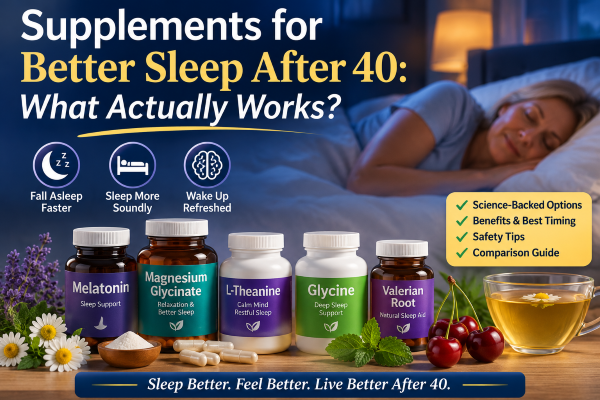
If you’re over 40 and lying awake at night, a handful of supplements can genuinely help — but the marketing around them is far louder than the evidence. The supplements with the strongest support for better sleep after 40 are melatonin (for circadian-rhythm and jet-lag issues), magnesium glycinate (for relaxation and muscle tension), glycine and L-theanine (for calming a racing mind and falling asleep faster), and a short list of gentle botanicals like valerian, chamomile, and tart cherry. Below is a clear, no-hype breakdown of what each one does, who should avoid it, the best time to take it, and how the research stacks up — plus a comparison table and links to deeper guides on insomnia, cortisol, and your sleep environment.
This guide is for general information and is not medical advice. Talk to your doctor before starting any supplement, especially if you take prescription medication or have a health condition.
Melatonin
Melatonin is a hormone your brain naturally releases in response to darkness. After 40, melatonin production can shift and weaken, which is one reason sleep tends to get lighter and more fragmented with age. A low-dose supplement doesn’t sedate you — it simply signals to your body that it’s time to wind down.
- Who it helps: people with circadian-rhythm disruptions, shift workers, frequent travelers, and anyone who struggles to fall asleep at a consistent time. If you regularly wake between 2 a.m. and 4 a.m. because of a shifted rhythm, correctly timed melatonin can help reset that internal clock.
- Who should avoid it: anyone who is pregnant or breastfeeding, people taking blood thinners or immunosuppressants, and those with autoimmune conditions should check with a doctor first. High doses can also cause vivid dreams or morning grogginess.
- Best time to take it: 30–60 minutes before bed. Lower is better — 0.5 to 3 mg is often enough. More is not stronger, and very high doses can backfire.
Magnesium
Magnesium is involved in hundreds of body processes, including the relaxation of muscles and the calming of the nervous system. Low intake is common after 40, and correcting a shortfall can make it easier to switch off at night. Not all forms are equal, so the type matters.
- Magnesium Glycinate — bound to glycine, highly absorbable and gentle on the stomach. The best choice for sleep and relaxation.
- Magnesium Citrate — well absorbed but more likely to have a laxative effect; better suited to those who also want regularity.
- Magnesium Oxide — cheap and poorly absorbed. Not the best pick for sleep despite the lower price tag.
Evidence for magnesium and sleep is moderate — several studies link supplementation to improved sleep quality and fewer nighttime awakenings, especially in older adults. Keep total supplemental intake under roughly 350 mg of elemental magnesium daily unless a clinician advises otherwise, and take it apart from certain medications such as some antibiotics and thyroid drugs.
Glycine
Glycine is a small amino acid that acts as a calming neurotransmitter. A typical dose of about 3 grams before bed has been shown in small studies to help people fall asleep faster and rate their sleep quality higher. It may also gently lower core body temperature, which supports the natural drop your body needs to drift off. It’s tasteless, mixes into water, and is very well tolerated.
L-Theanine
L-theanine, found naturally in tea leaves, promotes alpha brain waves associated with a relaxed-but-alert state. Taken as a supplement (usually 100–200 mg) in the evening, it can take the edge off a stressed, racing mind — the kind that shows up after a hard day and then hijacks your sleep through cortisol. It pairs well with magnesium for nighttime calm without drowsiness.
Valerian Root
Valerian is one of the most studied herbal sleep aids. Some people find it shortens the time it takes to fall asleep and improves sleep quality, though results are mixed and it can have a strong smell or cause mild morning grogginess. Think of it as a gentle option worth trying for a couple of weeks to see if it helps you.
Chamomile
Chamomile is best known as a calming tea. The compound apigenin binds to receptors in the brain that may promote sleepiness. A cup of strong chamomile tea in the evening is a low-risk ritual that tells your body it’s time to wind down — and the routine itself helps. Pair it with a consistent sleep environment for the best effect.
Lavender
Lavender is unusual in that it works best through smell rather than a pill. Inhaling lavender oil — via a diffuser or a drop on the pillow — has shown modest benefits for sleep quality and relaxation in several studies. It’s a simple, drug-free add-on that fits naturally into a calm bedroom setup.
Ashwagandha
Ashwagandha is an adaptogenic herb that helps the body manage stress. Because elevated stress is a major sleep disruptor, reducing that load can indirectly improve rest. Some trials using standardized extracts report better sleep and lower anxiety. Give it a few weeks — adaptogens build gradually rather than working the first night.
Lemon Balm
Lemon balm, a member of the mint family, has mild calming effects. Often combined with valerian, it may help reduce restlessness and support sleep onset. It’s generally well tolerated at typical doses and makes a pleasant evening tea on its own.
Tart Cherry
Tart cherry juice is one of the few foods naturally rich in melatonin, and it also supports the availability of tryptophan, a building block of sleep hormones. Small studies suggest it can improve sleep duration and quality, particularly in older adults. A modest serving in the evening is the typical approach — see our guide on how diet affects sleep for more food-based tips.
Vitamin D (When Deficiency Affects Sleep)
Vitamin D isn’t a sleep aid in the usual sense, but low levels are linked to poorer sleep and more nighttime awakenings. If a blood test shows deficiency — common in adults who spend little time outdoors — correcting it can improve several aspects of health, including rest. It’s worth checking with your doctor rather than guessing.
Omega-3s
Omega-3 fatty acids (especially EPA and DHA) support overall brain and cardiovascular health, and some research connects higher omega-3 status with better sleep efficiency and fewer disturbances. The benefits are subtle and build over time, but they’re a worthwhile part of a healthy-aging routine that also protects your joints and heart.
B Vitamins
B vitamins — particularly B6, folate (B9), and B12 — support the production of neurotransmitters like serotonin and melatonin. A shortfall won’t be fixed by a mega-dose, but balanced intake through diet or a standard B-complex keeps those pathways running. If fatigue and poor sleep overlap, a deficiency is worth ruling out.
How They Compare
| Supplement | Best For | Evidence | Time to Take |
|---|---|---|---|
| Melatonin | Jet lag / circadian rhythm | Strong | 30–60 min before bed |
| Magnesium Glycinate | Relaxation, muscle tension | Moderate | Evening |
| L-Theanine | Stress, racing mind | Moderate | Evening |
| Glycine | Falling asleep faster | Moderate | Before bed |
| Valerian Root | Sleep onset, restlessness | Mixed | 1–2 hrs before bed |
| Chamomile | Wind-down ritual | Mild–Moderate | Evening tea |
| Tart Cherry | Sleep duration | Moderate | Evening |
| Ashwagandha | Stress-related sleep | Moderate | With dinner |
How to Combine Them Safely
You don’t need all of these at once. A practical stack for many people over 40 is magnesium glycinate in the evening plus a calming herbal like chamomile or lemon balm, adding melatonin only for rhythm issues and L-theanine or glycine on more stressful nights. Start one at a time so you can tell what’s actually working — and keep your doctor in the loop if you take any medication.
Frequently Asked Questions
Can I take sleep supplements every night?
Some are fine for nightly use — magnesium glycinate, glycine, and chamomile are generally safe long term. Others, like melatonin, are better cycled or reserved for specific issues rather than taken indefinitely. If you find you “can’t sleep without it,” that’s a sign to step back and rebuild your habits first.
Are sleep supplements safe with prescription medications?
Not always. Valerian, melatonin, and ashwagandha can interact with sedatives, blood thinners, thyroid, and diabetes medications. Always run your supplement list past a pharmacist or doctor, especially after 40 when taking several medications at once is more common. Our Insomnia After 40 guide covers the broader picture.
How long before bed should I take magnesium?
Magnesium glycinate works best taken 30–60 minutes before bed, often alongside a calming routine. It’s not a sedative, so consistency matters more than precise timing. A cool, dark sleep environment does more of the heavy lifting than the exact minute you take it.
Which supplement is best if I wake up at 2–4 a.m.?
Waking in the small hours usually points to a circadian or stress issue. Low-dose melatonin (timed earlier in the evening) helps if it’s rhythm-related, while L-theanine or ashwagandha may help if stress is the driver. If it’s frequent, review your cortisol patterns and wind-down routine first — see our piece on waking between 2 a.m. and 4 a.m. for the root causes.
Do these supplements replace good sleep habits?
No. Supplements are the roughly 10% that supports the 90%: a consistent schedule, a dark and cool room, limited evening screens, and stress management. The guides on breathing exercises for sleep, napping after 40, and sleep tracking show how to build that foundation — supplements work best on top of it, not instead of it. And if morning stiffness or joint pain from poor sleep is part of the picture, those articles complete the loop.
More Sleep Guides on HealthWellnessWay
- Insomnia After 40: Why It Happens and What Actually Helps
- Why Do I Wake Between 2 AM and 4 AM Every Night?
- How Stress and Cortisol Ruin Sleep Quality After 40
- Sleep Environment: Temperature, Light, and Sound After 40
- How Diet Affects Sleep After 40
- Breathing Exercises for Sleep: 4 Techniques That Actually Work
- Napping After 40: Benefits, Risks, and How to Do It Right
- Sleep Tracking After 40: What the Data Means
- Why Do I Wake Up Stiff Every Morning After 40?
- Can Lack of Sleep Make Joint Pain Worse?