
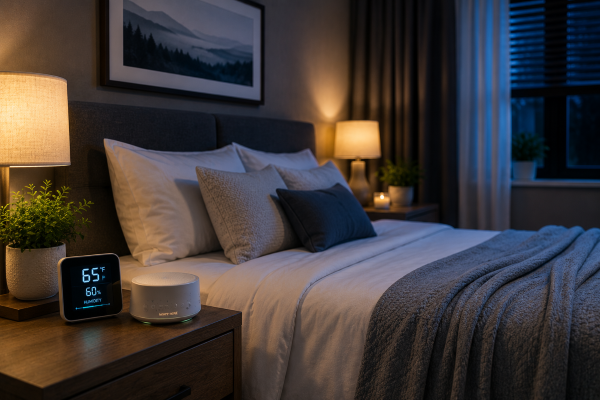
Your bedroom environment plays a major role in how well you sleep. Temperature, light, sound, and even the materials on your mattress and pillow can silently sabotage or dramatically improve—your rest after 40. This guide covers what the science says about each environmental factor and exactly how to optimize your bedroom for deeper, less fragmented sleep. Small changes here often deliver bigger results than any supplement or sleep gadget.
Quick Answer: Your Bedroom Controls Your Sleep
Your body needs specific environmental conditions to initiate and maintain deep sleep. A bedroom that is too warm, too bright, or too noisy can cut into both deep and REM sleep, even if you get a full eight hours in bed. After 40, when deep sleep naturally declines, a poor environment makes the problem significantly worse. Optimizing temperature, light, and sound is one of the fastest, cheapest ways to improve sleep quality after 40.
How Temperature Affects Sleep After 40
Your core body temperature needs to drop by about two to three degrees Fahrenheit to initiate sleep. This is controlled by your circadian rhythm and happens naturally as evening approaches. A bedroom that is too warm blocks this cooling process, delaying sleep onset and reducing deep sleep.
Research consistently shows that the optimal bedroom temperature for most adults is between 60 and 67 degrees Fahrenheit. Warmer rooms, especially above 72 degrees, are associated with more awakenings, less REM sleep, and lower sleep efficiency. After 40, this effect is amplified because your thermoregulatory system becomes less efficient.
Practical temperature tips
- Keep your thermostat between 60 and 67 degrees at night
- Use breathable, moisture-wicking sheets and pajamas made from cotton or bamboo
- Avoid electric blankets or heating pads in bed—they raise core temperature and disrupt sleep cycles
- Take a warm shower or bath 90 minutes before bed; the subsequent cool-down triggers sleepiness
How Light Affects Your Sleep
Light is the single most powerful external signal for your circadian clock. Blue light from phones, tablets, TVs, and LED bulbs suppresses melatonin, the hormone that signals sleep onset. Exposure to bright light—especially blue light—within two hours of bed can shift your circadian rhythm later, making it harder to fall asleep at your desired time and reducing overall sleep quality.
Evening light strategies
- Use blue light filters on screens after sunset, or avoid screens for the final 60 minutes before bed
- Switch to warm, dim lighting in the evening—use lamps instead of overhead lights
- Keep electronic devices out of the bedroom if possible, or at least off and face-down
- Wear blue-light-blocking glasses in the evening if you must use screens
Morning light strategies
Just as evening light disrupts sleep, morning light strengthens it. Getting natural light within the first 30 to 60 minutes of waking anchors your circadian rhythm, making it easier to fall asleep at night and wake up refreshed. Open your curtains as soon as you get up, or step outside for a few minutes. For more on this habit, see How to Sleep Better Naturally After 40.
How Sound Affects Sleep Quality
Sound disruptions—traffic, a partner’s snoring, a neighbor’s dog, household noises—can pull you out of deep sleep and trigger a full awakening. After 40, when sleep is naturally lighter, auditory disruptions have a bigger impact. Even low-level background noise can reduce time spent in restorative sleep stages.
Sound solutions
- Use a white noise machine or a fan to mask unpredictable background sounds
- Try pink noise or brown noise for a deeper, less harsh sound profile
- Use earplugs if your partner snores or if environmental noise is unavoidable
- Address snoring directly—loud, frequent snoring may be a sign of sleep apnea
- Record bedroom noise levels with a sound meter app to identify hidden disruptors
Your Mattress and Pillow After 40
Your mattress and pillow have a direct impact on spinal alignment, joint pressure, and sleep comfort. After 40, reduced cartilage and increased joint sensitivity mean that an old or unsupportive mattress can cause micro-awakenings from discomfort you may not even consciously notice.
When to replace your mattress
Most mattresses begin losing support after seven to ten years. Signs yours may be past its prime include waking up with back or joint pain, feeling springs or lumps, noticing sagging, or simply sleeping worse in your own bed than when traveling. If your mattress is over eight years old and your sleep has declined, a new one may be one of the highest-ROI sleep investments you make. For bedding and pillow recommendations, see Best Pillows for Neck and Shoulder Pain.
Pillow selection by sleep position
Side sleepers need a higher, firmer pillow to keep the neck aligned with the spine. Back sleepers need medium support that keeps the head from tilting forward. Stomach sleepers need a very thin pillow or no pillow at all to avoid neck strain. Many adults over 40 switch positions due to joint pain, so adjustable or layered pillows can be worth considering.
Air Quality and Sleep
Indoor air quality affects oxygen levels and respiratory comfort during sleep. Stuffy, dry, or allergen-heavy air can cause light, fragmented sleep, especially for adults with asthma, allergies, or sensitive airways. Simple interventions include opening a window for fresh air circulation, using an air purifier with a HEPA filter, and maintaining indoor humidity between 30 and 50 percent. A humidifier in dry winter months can prevent dry nasal passages and throat irritation that disrupt sleep.
Organizing Your Bedroom for Better Sleep
A cluttered bedroom subconsciously signals activity and stress to your brain. Keeping your sleep space tidy, calm, and dedicated to rest (and intimacy only) helps your nervous system associate the environment with safety and relaxation. Remove work materials, exercise equipment, and screens from the bedroom where possible.
Frequently Asked Questions
What room temperature is best for sleep after 40?
Most adults sleep best between 60 and 67 degrees Fahrenheit. After 40, aim for the cooler end of this range, as thermoregulation becomes less efficient. Individual preferences vary—adjust by one-degree increments until you find your optimal zone.
Does blue light really affect sleep?
Yes. Blue light is the strongest suppressor of melatonin among visible light wavelengths. Even brief exposure to a phone screen within an hour of bed measurably reduces melatonin and shifts sleep timing later. The effect is comparable to drinking a small cup of coffee.
Is white noise better than earplugs?
White noise masks environmental sounds by creating a steady audio backdrop, making sudden noises less jarring. Earplugs block sound entirely but can feel uncomfortable or unsafe for people who need to hear alarms or children. Many adults alternate between both depending on the night.
How often should you replace your pillow?
Most pillows should be replaced every 18 to 24 months. Over time, they lose their loft and support, which strains the neck and spine. If you wake up with neck pain or your pillow feels flat, lumpy, or uneven, it is time for a new one.
Can sleep position affect how rested you feel?
Sleep position matters for spinal alignment and airway patency. Side sleeping with a pillow between the knees is generally best for adults with joint pain. Back sleeping can worsen snoring and sleep apnea. Stomach sleeping strains the neck and is generally discouraged after 40.
Links to Explore
For more on optimizing your sleep, comfort, and wellness after 40, explore these related articles on HealthWellnessWay.com.