
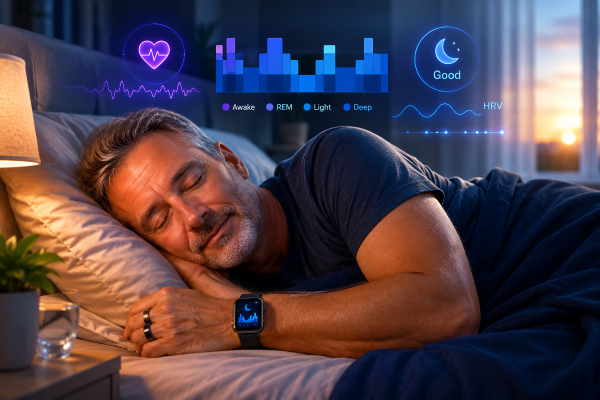
Sleep tracking has exploded in popularity, but for adults over 40 it raises a specific question: is the data helpful, or is it creating new anxiety around sleep? Wearable devices like Apple Watch, Fitbit, Garmin, Whoop, and Oura Ring promise detailed insights into sleep stages, heart rate, and recovery, but the data is only useful if you know how to interpret it and act on it without obsessing. This guide explains what sleep tracking actually measures, what the data means after 40, which metrics matter most, and how to use a tracker to improve your rest without letting it become a source of stress.
Quick Answer: Sleep Tracking Can Help After 40—If Used Wisely
Sleep trackers are not diagnostic tools, but they can reveal patterns—an irregular schedule, frequent nighttime awakenings, insufficient deep sleep—that you would otherwise miss. For adults whose sleep has gradually worsened with age, a tracker can provide objective feedback that motivates positive changes. The key is using the data as a guide, not a scorecard, and knowing which metrics are reliable versus which are best treated as estimates.
What Sleep Trackers Actually Measure
Most consumer sleep trackers rely on a combination of movement (accelerometer), heart rate (optical sensor), and sometimes heart rate variability (HRV) to estimate sleep stages. They do not measure brainwave activity directly—that requires a clinical polysomnography (PSG) sleep study. This distinction matters because tracker-estimated sleep stages can be off by meaningful amounts, especially in adults over 40 with lighter or more fragmented sleep patterns.
How trackers estimate deep sleep and REM
Trackers infer deep sleep from periods of very low movement, a slower heart rate, and stable HRV. REM sleep is estimated from periods of low movement combined with higher, more variable heart rate. In practice, this works reasonably well for detecting total sleep time but is less accurate at pinning down exact sleep stage durations. Take sleep stage percentages with a grain of salt—especially if your score causes anxiety.
Heart rate and heart rate variability
Resting heart rate and HRV are among the most reliable metrics from consumer trackers. A lower average resting heart rate and higher HRV generally indicate better cardiovascular fitness and lower stress. These metrics are useful for tracking trends over time rather than fixating on nightly numbers.
What Matters Most for Sleep Tracking After 40
Not all data points are equally useful. Here are the metrics to actually watch, and the ones to largely ignore.
- Total sleep time — Most reliable metric. Easy to cross-check against your actual bedtime and wake time.
- Sleep consistency (bedtime and wake time variation) — One of the most actionable insights a tracker provides. Irregular schedules are a major driver of poor sleep after 40.
- Resting heart rate trend — A declining trend generally signals improving fitness and recovery; a sudden spike may indicate illness, overtraining, or stress.
- HRV trend — Best viewed over weeks. Use it to understand your stress baseline rather than as a nightly sleep score.
- Wake frequency — Knowing that you are waking three to four times per night can be useful context when discussing sleep with your doctor.
Less useful: overly precise sleep stage percentages, which can be inaccurate and tend to trigger obsessive monitoring. Why Am I Tired After 8 Hours of Sleep? explains why stage breakdowns are less important than overall sleep quality.
How to Use Your Tracker Data to Actually Improve Sleep
A tracker is only as useful as the changes it prompts. Here is how to turn data into progress.
Look for patterns, not single nights
One bad night is not a trend. Look at weekly and monthly averages. Is your bedtime shifting later each night? Are wake times getting earlier? These patterns are more actionable than a single low sleep score. For more on consistent schedules, see How to Build a Simple Bedtime Routine.
Test one change at a time
If you identify a problem—say, frequent nighttime awakenings—test one variable: earlier caffeine cutoff, cooler room, or an earlier dinner. Track the change for two weeks and compare. This methodical approach avoids the common mistake of changing everything at once and then not knowing what helped.
Use HRV to manage stress and exercise
If HRV drops consistently for several days, it may indicate your stress load is too high or you are overtraining. Use this as a signal to prioritize recovery—gentle movement, breathing exercises, more sleep, or a break. For stress management strategies tied to sleep, see How Stress and Cortisol Ruin Sleep Quality After 40.
Know when to stop checking
Orthosomnia is a growing phenomenon where people become so fixated on optimizing their sleep scores that they develop anxiety about sleep—which ironically makes sleep worse. If your tracker is causing stress rather than reducing it, take a break from it for a week or two. Your sleep does not need a device to tell you whether it is improving; feeling more rested is the best metric.
When a Tracker Alone Is Not Enough
Consumer trackers are great for pattern detection but cannot diagnose sleep disorders. If your tracker consistently shows concerning patterns—very low deep sleep, high wake frequency, elevated resting heart rate, or you experience daytime exhaustion despite full nights—those are signs to seek a professional sleep evaluation.
A sleep study can diagnose sleep apnea, restless legs syndrome, periodic limb movement disorder, and other conditions that no consumer tracker can detect. If you suspect an underlying issue, a tracker is a starting point, not a final answer. Learn more about when to seek evaluation at Why Is My Sleep Worse After Age 50?.
Choosing a Sleep Tracker After 40
Not all trackers are equal for sleep tracking. Here are factors to consider for adults over 40.
Form factor
Wrist-based trackers (watch or band) are convenient but can feel uncomfortable for sleeping. Finger rings (Oura, Ultrahuman) are lighter and often produce more consistent data. Chest straps are the most accurate for heart rate but may feel restrictive. Choose based on what you will actually wear consistently.
Sleep staging accuracy
Look for devices validated against PSG in independent studies. Some brands publish their validation data; others do not. Reviews from sleep researchers and independent testing organizations can help identify which devices produce the most reliable stage estimates.
App usability and trend reporting
A tracker is only as good as the insights its app provides. Look for clear trend graphs, easy-to-understand summaries, and actionable recommendations. Avoid devices whose apps feel designed to stress you out with daily scores and social comparisons.
Frequently Asked Questions
Are sleep trackers accurate after 40?
Total sleep time is generally accurate. Sleep stage percentages are less reliable, especially in adults over 40 whose sleep patterns are more fragmented. Heart rate and heart rate variability (HRV) trends are generally among the most reliable measurements available from consumer sleep trackers.
Can a sleep tracker diagnose sleep apnea?
Many trackers flag possible apnea events based on oxygen saturation and heart rate patterns, but they cannot diagnose it. If your tracker indicates possible apnea—snoring pauses, oxygen dips, elevated resting heart rate—talk to your doctor about a sleep study.
Is checking my sleep score every morning healthy?
Not necessarily. Obsessively checking scores can create sleep performance anxiety, which raises cortisol and makes sleep worse. Check your tracker data once or twice a week at most, or set it to notify you only of significant changes rather than daily scores.
Should I wear my tracker every night?
For consistent trend data, wearing it most nights is useful. But give yourself a full break at least one night per week. This helps you tune into your body’s natural signals without a device mediating your experience, and it reduces orthosomnia risk.
Can a sleep tracker help me sleep better?
Yes, when used thoughtfully. Identifying schedule patterns, experimenting with changes, and tracking trends over time can help you pinpoint what works for your specific sleep needs. The improvement comes from the behavior changes the data motivates—not from the device itself.
Links to Explore
For more on sleep quality, habits, and common sleep problems after 40, explore these related articles on HealthWellnessWay.com.